HYPRAEL closes 2025 with key material validation milestones and sets course for 50kW industrial scaling in 2026

The HYPRAEL consortium, dedicated to developing next-generation Advanced Alkaline Electrolysis (AEL) for highly pressurized hydrogen production, concludes 2025 having successfully achieved crucial milestones in materials research and international visibility. The project, funded by the Clean Hydrogen Partnership under Horizon Europe, is now strategically positioned for the final industrial scaling phase in 2026.

Key technical and scientific achievements in 2025

The year 2025 was defined by the successful completion of Phase 1 (materials development) and the highly successful Phase 2 (screening and testing) of the project. This involved validating innovative electrocatalysts, separators, and polymers capable of withstanding the demanding operational parameters of the HYPRAEL system.

  • High-temperature operation: Laboratory testing confirmed the stability and performance of developed cell components in single cells 10cm2 at temperatures up to 120º, a significant advance beyond the current state-of-the-art for AEL.

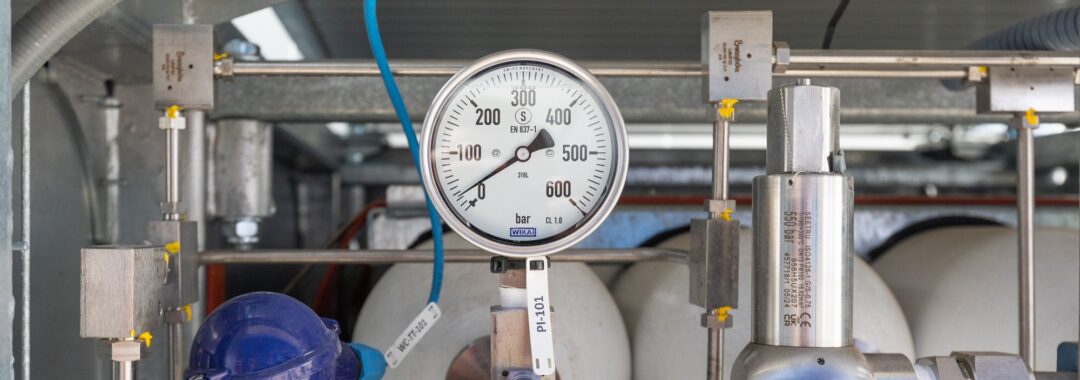
  • High-pressure feasibility: Critical data was gathered demonstrating the technical feasibility of in-situ pressurization, reinforcing the project’s goal of reaching 80-100 bar directly within the stack, thereby eliminating energy-intensive downstream mechanical compression processes and achieving near-zero energy loss potential.

Global impact and sustainability

HYPRAEL extended its reach globally, presenting its technical achievements at major international platforms:

  • Market Presence: The consortium presented its technical roadmap and initial results at high-profile events, including Hyvolution Paris (January 2025) and HANNOVER MESSE (May 2025), fostering dialogue with key industrial stakeholders regarding the viability of high-pressure AEL.

  • Sustainable Partnerships: The project’s commitment to sustainability was underscored by the environmental leadership of its partners. The recent CDP A- rating achieved by the consortium partner Syensqo highlights the project’s dedication to a responsible and sustainable supply chain for critical materials.

Vision 2026: the industrial leap

Looking ahead to 2026, the focus shifts entirely to the industrialization and demonstration phases (Phase 3 and 4).

2025 provided the technical proof of concept for our Advanced Alkaline Electrolysis. The data from 120ºC and high-pressure testing are extremely promising. In 2026, we will begin the assembly and rigorous testing of our innovative 50kW stack demonstrator. This will be the definitive validation step for transferring this highly efficient and cost-effective hydrogen production technology to the market.

hyprael-green-hydrogen-electrolyzer-at-80-bar

HYPRAEL: the project that wants hydrogen to breathe pressurized?

In European laboratories, driving high pressure green hydrogen production, where steel pipes intertwine like arteries and steam sketches invisible maps in the air, teams of engineers are driven by a shared obsession: to free hydrogen — as much as possible — from its dependence on mechanical compressors. Learn more about the project’s foundations on the  .

This isn’t science fiction. It’s HYPRAEL, a project that sounds futuristic but is being built, quite literally, with hands in the present. Its goal is as bold as it is concrete: to produce green hydrogen directly at pressures beyond today’s state of the art, drastically reducing the need for mechanical compression afterward.

When the challenge is invisible, but heavy: compression

Today, producing hydrogen isn’t the main issue. The real challenge comes next. To store or transport it, it must be compressed. And that costs energy, money, and time. HYPRAEL aims to skip that step — or at least, make it much smaller.

The alkaline alchemy

The chosen technology isn’t new, but the ambition behind it is. Alkaline electrolysis has been used for decades, but it has never been pushed this far: to operate above 30 bar, to explore its limits and aim for 50 or even 80 bar of pressure, while also improving efficiency at higher temperatures — with advanced, sustainable materials and minimal loss in performance. It’s like asking a bicycle to compete with a bullet train… and win. Discover the full scope of the initiative through its listing on .

But the researchers aren’t intimidated. They’re redesigning cells, testing new electrodes and separators, and fine-tuning each parameter like a symphony. Because they know that if this works, it could change the rules of the game.

Beyond the lab

HYPRAEL doesn’t stop at academic papers. It’s grounded and focused on the industry. The project will validate prototypes under real-world conditions, measure environmental and economic impact, and work toward a future where Europe not only consumes green hydrogen — but produces it with homegrown technology. Read how the is coordinating this European effort. View the project details on the .

A European effort, built together HYPRAEL is not a solo endeavor — it’s powered by a consortium of leading institutions and companies across Europe. Coordinated by the Aragon Hydrogen Foundation, the project brings together key players such as Fraunhofer, Green Hydrogen System, AGFA, VECO, and Syensqo. Each partner contributes its expertise: from advanced materials and cell design to industrial validation and process engineering. This collective effort ensures that HYPRAEL’s innovations are not only technically sound, but scalable, sustainable, and aligned with Europe’s vision for clean hydrogen production.