High-pressure hydrogen production-hyprael

HYPRAEL to present at X-SEED project second workshop on high-pressure hydrogen production


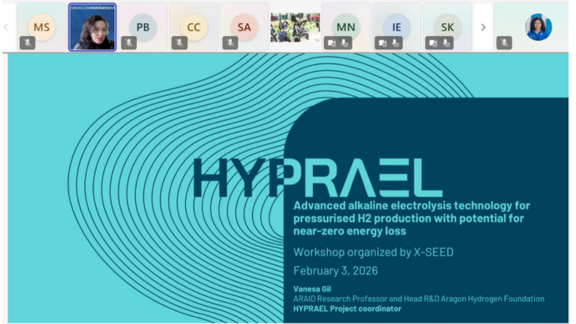
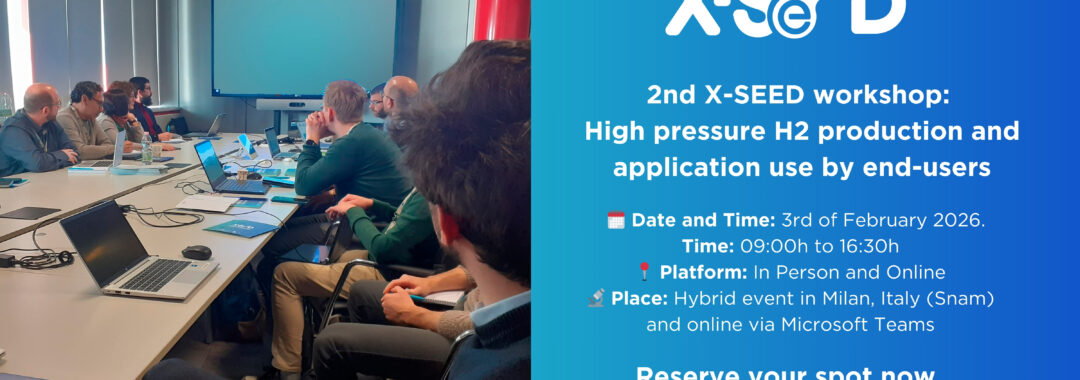
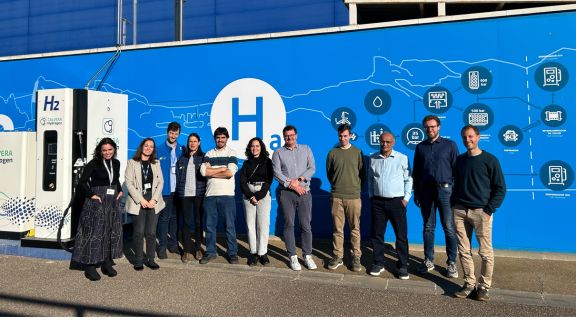
The HYPRAEL project will participate in the X-SEED Project Second Workshop, a key event dedicated to high-pressure H₂ production and end-user applications. The workshop will take place on 3 February 2026 at Snam Facilities in Milan, Italy, with hybrid attendance options available.

About the workshop

This second X-SEED workshop brings together leading European projects and experts working on high-pressure hydrogen technologies. The event will focus on innovative approaches to hydrogen production at elevated pressures and real-world industrial applications where high-pressure H₂ plays a critical role.

HYPRAEL’s participation highlights the project’s pioneering work in pressurized alkaline electrolysis technology, which produces hydrogen directly at pressures exceeding 80 bar, eliminating the need for costly downstream mechanical compression.

Why this matters

High-pressure hydrogen production is essential for reducing the overall cost and energy consumption of green hydrogen systems. By connecting projects like HYPRAEL with end-users and industry stakeholders, the X-SEED workshop facilitates knowledge exchange and accelerates the path toward commercial deployment of advanced hydrogen technologies.

Workshop Highlights

Attendees will have the opportunity to:

Connect with leading projects and experts in hydrogen technologies
Discover the latest developments in high-pressure hydrogen production
Learn how renewable hydrogen is being implemented in industrial applications
Visit Snam facilities (for onsite participants)

Event details

Date: 3 February 2026
Time: 09:00 – 16:30 CET
Location: Snam Facilities, Piazza Santa Barbara 7, San Donato Milanese, Milan, Italy
Format: Hybrid (in-person and online participation available)

Onsite participants will also have the unique opportunity to tour Snam’s hydrogen facilities, gaining firsthand insight into real-world hydrogen infrastructure.

Join the conversation

Whether attending in person or online, this workshop represents a valuable opportunity to explore the future of hydrogen, connect with the European hydrogen community, and discover practical pathways for implementing renewable H₂ in industry.

For agenda details and registration information, visit the X-SEED workshop page.


About HYPRAEL

HYPRAEL is a European innovation project developing advanced pressurized alkaline electrolysis technology for more efficient and cost-effective green hydrogen production. The project aims to produce hydrogen at pressures above 80 bar and temperatures up to 120°C, using sustainable PGM/CRM-free materials.

Funded by the Clean Hydrogen Partnership under Grant Agreement No 101101452, HYPRAEL brings together leading European research institutions and industry partners including Aragon Hydrogen Foundation (coordinator), Fraunhofer IWS, AGFA, VECO, and Syensqo.

For more information:
Website: www.hyprael.eu
LinkedIn: HYPRAEL Project
Twitter/X: @HYPRAEL_EU


hyprael-aims-to-reduce-energy-consumption-in-h2-production

HYPRAEL analysis: does Berkeley’s AEM breakthrough threaten or validate alkaline electrolysis (AEL) leadership?

Experts at HYPRAEL evaluate the impact of UC Berkeley’s new AEM electrolyzer design on durability and cost. Discover why AEL technology remains the most viable and scalable choice for industrial green hydrogen production.

The global clean energy community is buzzing about the recent announcement from UC Berkeley regarding a significant milestone in Anion Exchange Membrane (AEM) electrolyzer technology. The research claims to have mitigated the crucial issue of polymer degradation, potentially lowering manufacturing costs dramatically. This development, while impressive, requires careful strategic context. As specialists in Alkaline Electrolysis (AEL), HYPRAEL recognizes the importance of the research, yet we must underscore the proven maturity of AEL. This article details the key differences, the strategic market response, and why AEL continues to hold the industrial advantage in longevity, tested efficiency, and current scale. Read on for our detailed technological comparison.

AEM’s theoretical cost vs. AEL’s industrial reality

While the cost reduction potential of AEM is appealing, the technology must now transition from lab success to multi-megawatt industrial reliability—a threshold AEL has surpassed for decades. AEL, by utilizing robust and inexpensive liquid electrolytes, avoids the high material costs associated with some membrane systems, making its operational expenditure (OPEX) highly competitive over the long term. This operational stability, essential for continuous industrial output, is the critical advantage AEM must still prove.

Why longevity and efficiency drive HYPRAEL’s AEL strategy

The key metric for industrial-scale deployment is the total cost of ownership (TCO). The long lifespan and established recycling processes of AEL components contribute significantly to its lower TCO. HYPRAEL remains focused on refining AEL’s efficiency curve and further reducing its capital expenditure (CAPEX) to maintain our edge. The Berkeley study, by tackling durability, highlights the fundamental engineering trade-offs inherent in all electrolysis methods.

The hydrogen future: a strong market built on strong competition

HYPRAEL views the progress in AEM as beneficial for the entire green hydrogen sector. Increased competition fosters innovation and validates the global commitment to electrifying fuel production. Our message is clear: the technology is mature, the investment is urgent, and Alkaline Electrolysis (AEL) is the reliable choice for today’s large-scale projects.

Contact HYPRAEL today to discuss how AEL can power your next industrial descarbonization project.

HYPRAEL closes 2025 with key material validation milestones and sets course for 50kW industrial scaling in 2026

The HYPRAEL consortium, dedicated to developing next-generation Advanced Alkaline Electrolysis (AEL) for highly pressurized hydrogen production, concludes 2025 having successfully achieved crucial milestones in materials research and international visibility. The project, funded by the Clean Hydrogen Partnership under Horizon Europe, is now strategically positioned for the final industrial scaling phase in 2026.

Key technical and scientific achievements in 2025

The year 2025 was defined by the successful completion of Phase 1 (materials development) and the highly successful Phase 2 (screening and testing) of the project. This involved validating innovative electrocatalysts, separators, and polymers capable of withstanding the demanding operational parameters of the HYPRAEL system.

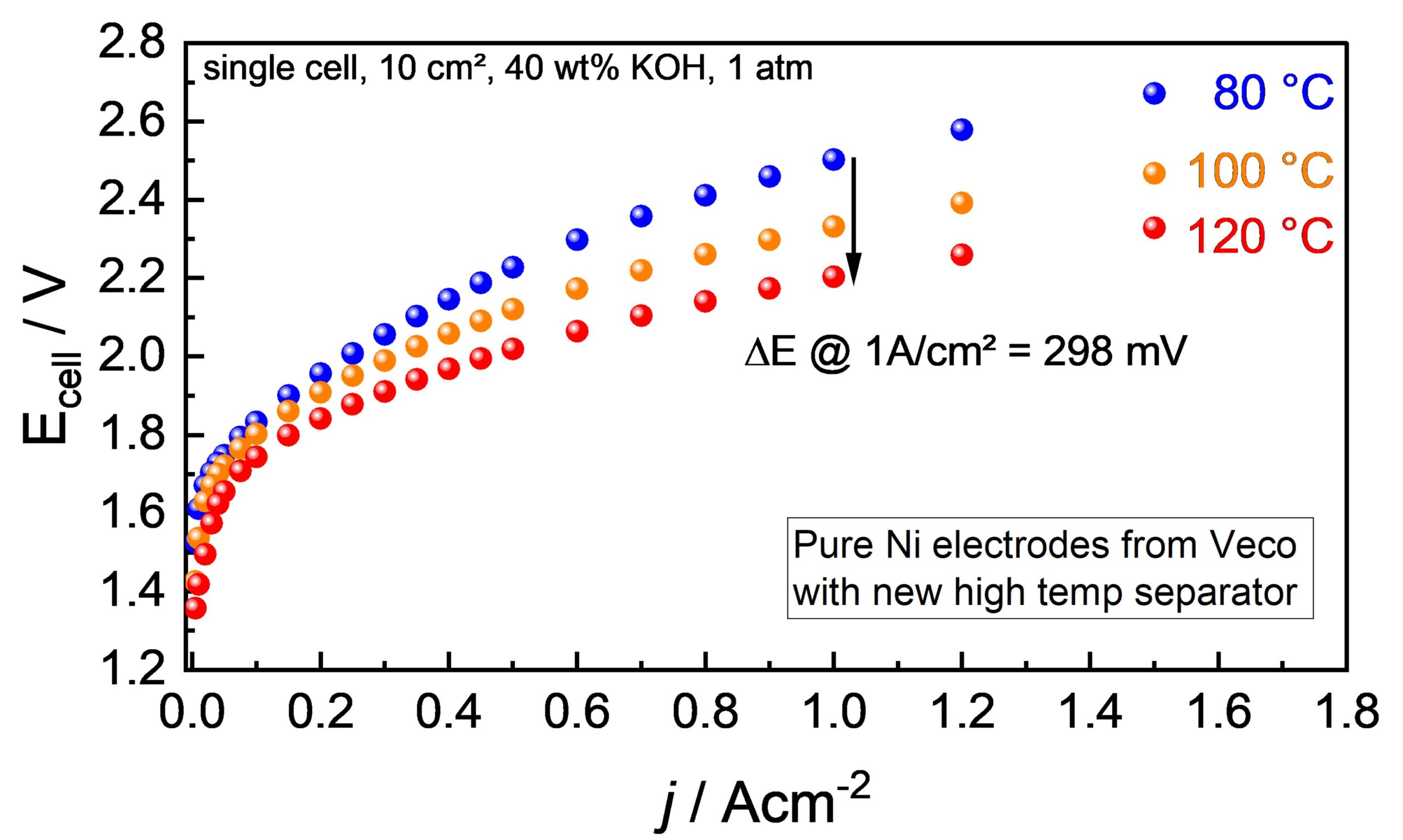
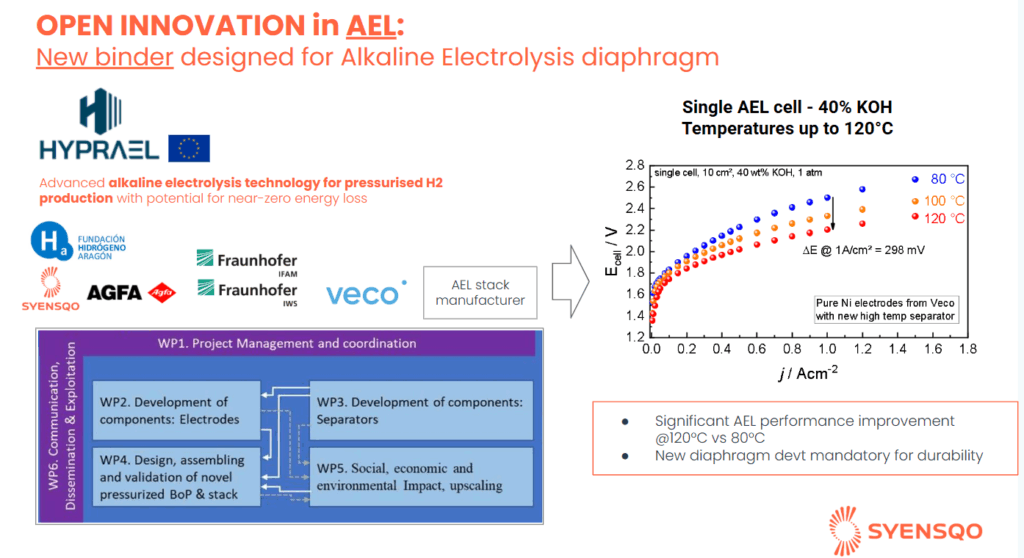
  • High-temperature operation: Laboratory testing confirmed the stability and performance of developed cell components in single cells 10cm2 at temperatures up to 120º, a significant advance beyond the current state-of-the-art for AEL.

  • High-pressure feasibility: Critical data was gathered demonstrating the technical feasibility of in-situ pressurization, reinforcing the project’s goal of reaching 80-100 bar directly within the stack, thereby eliminating energy-intensive downstream mechanical compression processes and achieving near-zero energy loss potential.

Global impact and sustainability

HYPRAEL extended its reach globally, presenting its technical achievements at major international platforms:

  • Market Presence: The consortium presented its technical roadmap and initial results at high-profile events, including Hyvolution Paris (January 2025) and HANNOVER MESSE (May 2025), fostering dialogue with key industrial stakeholders regarding the viability of high-pressure AEL.

  • Sustainable Partnerships: The project’s commitment to sustainability was underscored by the environmental leadership of its partners. The recent CDP A- rating achieved by the consortium partner Syensqo highlights the project’s dedication to a responsible and sustainable supply chain for critical materials.

Vision 2026: the industrial leap

Looking ahead to 2026, the focus shifts entirely to the industrialization and demonstration phases (Phase 3 and 4).

2025 provided the technical proof of concept for our Advanced Alkaline Electrolysis. The data from 120ºC and high-pressure testing are extremely promising. In 2026, we will begin the assembly and rigorous testing of our innovative 50kW stack demonstrator. This will be the definitive validation step for transferring this highly efficient and cost-effective hydrogen production technology to the market.

Alkaline electrolysis: 8% of european publications confirms its technological dominance

HYPRAEL, a leader in alkaline electrolysis (AEL) solutions for green hydrogen production, welcomes the publication of The Hydrogen Education and Research Landscape report (October 2025). The report highlights the relevance and growing attention the European scientific community is dedicating to alkaline technology.

The analysis, which tracks publications and patents across Europe (EU27, EFTA, and UK) from 2006 to 2025, reveals that alkaline electrolysis accounts for 8% of the total publications identified in the fields of clean hydrogen production, storage, and fuel cells.

The focus shifts to production

This data point is critical, as the study notes a “growing emphasis on publications and patents related to hydrogen production.”

AEL, being the most mature, proven production technology with lower manufacturing costs (as it does not require precious metals as catalysts), is positioned as the most robust and cost-effective solution to meet the increasing demand for green hydrogen at industrial scale.

The report also highlights the presence of alkaline technology in the fuel cell sector, where it accounts for 5% of publications.

HYPRAEL invites media and industry stakeholders to review the full report and visit its website to explore how its state-of-the-art alkaline electrolysers are optimising efficiency and lowering the cost of green hydrogen.

syensqo-cdp-hyprael-sustainability-hydrogen

HYPRAEL partner Syensqo secures elite CDP climate leadership status in debut year

The Belgian chemical giant achieves A- rating among global top 5%, reinforcing HYPRAEL’s commitment to sustainable innovation

Elite performance in first independent year

HYPRAEL project partner Syensqo has achieved remarkable sustainability leadership, securing an A- rating for Climate Change in Carbon Disclosure Project (CDP)‘s 2024 assessment—a distinction earned by fewer than 5% of companies globally. This green hydrogen industry achievement comes barely a year after Syensqo’s emergence as an independent entity, demonstrating the transformative sustainability leadership that makes projects like HYPRAEL successful.

Results that speak louder than promises

The sustainability metrics tell a compelling story for green hydrogen partnerships. Syensqo has delivered 50% of their 2030 greenhouse gas reduction targets ahead of schedule, with three out of four facilities now running on renewable electricity. Their comprehensive approach includes challenging scope 3 emissions, covering everything from raw materials to end-of-life treatment—exactly the holistic sustainability approach that HYPRAEL partner organizations require.

Supply chain leadership creates partnership value

Syensqo’s approach extends far beyond individual corporate sustainability goals. Their Supplier Climate Pledge covers 80% of emissions linked to raw material sourcing, creating supply chain advantages that HYPRAEL partners can leverage directly. This systematic approach to sustainability partnership creates competitive advantages across the entire green hydrogen value chain.

“Sustainability is central to our strategy, aligned with the needs of our customers and Syensqo’s long-term growth ambitions,” stated Titta Rosvall-Puplett, Chief Sustainability Officer at Syensqo. For HYPRAEL project development, partnering with organizations that have proven sustainability frameworks accelerates decarbonization objectives across industrial applications.

Beyond carbon: water stewardship excellence

The CDP recognition demonstrates multi-dimensional sustainability leadership. Syensqo earned an A rating for Supplier Engagement Assessment, landing on CDP’s exclusive “SEA A List,” while achieving a B rating for water stewardship. For green hydrogen projects often located in water-constrained regions, this operational excellence in resource management proves essential for project viability.

One planet roadmap: framework for industrial partnership

Syensqo’s “One Planet roadmap” provides the credible sustainability framework that serious industrial partnerships require. Targeting carbon neutral operations by 2040, with scope 1 and 2 emissions reduced by 42% by 2030 against a 2021 baseline, this roadmap aligns with Science Based Targets initiative validation.

The integrated water stewardship component reveals strategic thinking beyond carbon metrics. Syensqo’s commitment to reduce freshwater withdrawal by 20% by 2030 at water-scarce sites demonstrates the comprehensive sustainability approach that green hydrogen project partnerships demand.

Strategic implications for HYPRAEL

For HYPRAEL sustainability objectives, Syensqo’s CDP leadership status represents significant competitive advantages. Access to proven supply chains, operational expertise, and validated sustainability frameworks can accelerate the entire project timeline. When your chemical processing partner has already achieved 50% of their 2030 emissions challenge, your own decarbonization objectives become significantly more achievable.

Market timing and competitive advantage

This recognition comes at a crucial moment for green hydrogen industry partnerships. As sustainable hydrogen projects move from pilot to commercial scale, the difference between partners with demonstrated sustainability credentials and those still developing them could determine project viability.

Syensqo’s first-year CDP performance validates strategic partnership selections made during HYPRAEL project development. In an industry where sustainability claims often exceed delivery, partnering with demonstrated sustainability leaders creates competitive advantages that extend far beyond individual project boundaries.

hyprael-green-hydrogen-electrolyzer-at-80-bar

HYPRAEL: the project that wants hydrogen to breathe pressurized?

In European laboratories, driving high pressure green hydrogen production, where steel pipes intertwine like arteries and steam sketches invisible maps in the air, teams of engineers are driven by a shared obsession: to free hydrogen — as much as possible — from its dependence on mechanical compressors. Learn more about the project’s foundations on the  .

This isn’t science fiction. It’s HYPRAEL, a project that sounds futuristic but is being built, quite literally, with hands in the present. Its goal is as bold as it is concrete: to produce green hydrogen directly at pressures beyond today’s state of the art, drastically reducing the need for mechanical compression afterward.

When the challenge is invisible, but heavy: compression

Today, producing hydrogen isn’t the main issue. The real challenge comes next. To store or transport it, it must be compressed. And that costs energy, money, and time. HYPRAEL aims to skip that step — or at least, make it much smaller.

The alkaline alchemy

The chosen technology isn’t new, but the ambition behind it is. Alkaline electrolysis has been used for decades, but it has never been pushed this far: to operate above 30 bar, to explore its limits and aim for 50 or even 80 bar of pressure, while also improving efficiency at higher temperatures — with advanced, sustainable materials and minimal loss in performance. It’s like asking a bicycle to compete with a bullet train… and win. Discover the full scope of the initiative through its listing on .

But the researchers aren’t intimidated. They’re redesigning cells, testing new electrodes and separators, and fine-tuning each parameter like a symphony. Because they know that if this works, it could change the rules of the game.

Beyond the lab

HYPRAEL doesn’t stop at academic papers. It’s grounded and focused on the industry. The project will validate prototypes under real-world conditions, measure environmental and economic impact, and work toward a future where Europe not only consumes green hydrogen — but produces it with homegrown technology. Read how the is coordinating this European effort. View the project details on the .

A European effort, built together HYPRAEL is not a solo endeavor — it’s powered by a consortium of leading institutions and companies across Europe. Coordinated by the Aragon Hydrogen Foundation, the project brings together key players such as Fraunhofer, Green Hydrogen System, AGFA, VECO, and Syensqo. Each partner contributes its expertise: from advanced materials and cell design to industrial validation and process engineering. This collective effort ensures that HYPRAEL’s innovations are not only technically sound, but scalable, sustainable, and aligned with Europe’s vision for clean hydrogen production.

Electrolysis cell and green hydrogen production cost graph in HYPRAEL project

Green H2 electrolysis: low vs. high temp? | HYPRAEL Project & LCOH

The HYPRAEL project is diving deep into the complexities of green hydrogen production, focusing on a key question: which electrolysis method – low or high temperature – offers the most promising path to cost-effective and scalable solutions?

While both approaches have their merits, the project emphasizes that a thorough understanding of the Levelized Cost of Hydrogen (LCOH) is essential. The LCOH considers not only the electrolyzer technology itself, but also the crucial role of the electricity source. Whether it’s solar, wind, nuclear, or another renewable source, the choice significantly impacts the overall cost and efficiency of hydrogen production.

Why is this important?

Understanding the interplay between electrolysis temperature, electricity source, and production costs is vital for:

  • Strategic Decision-Making: Guiding investments and development efforts towards the most viable technologies.
  • Global Scalability: Making green hydrogen competitive with traditional fuels and enabling its widespread adoption.
  • Optimizing Efficiency: Identifying the ideal conditions for hydrogen production under various energy scenarios.

The HYPRAEL project aims to provide valuable insights into these critical factors, paving the way for a sustainable and economically sound hydrogen economy.

Learn more about the HYPRAEL project and its contributions to the advancement of green hydrogen technologies.

Explore the Manual calculator

electrolyzers-hyprael-hannover-2025-fraunhofer

HYPRAEL’s hydrogen innovations take center stage at HANNOVER MESSE!

Hannover, Germany – The HYPRAEL project is making waves at one of the world’s leading industrial trade fairs, HANNOVER MESSE! Our esteemed partner, Fraunhofer Institute for Material and Beam Technology IWS, is proudly showcasing cutting-edge hydrogen technology at their booth, highlighting the significant advancements being made within the HYPRAEL project.

Attendees visiting the Fraunhofer IWS booth have a unique opportunity to explore the groundbreaking work central to HYPRAEL, with a special focus on our innovative electrolysis technology. This visibility at a global event like Hannover Messe underscores the project’s commitment to pushing the boundaries of green hydrogen production.

Fraunhofer IWS’s crucial role in HYPRAEL:

Within the HYPRAEL consortium, Fraunhofer IWS plays a pivotal role in the development and optimization of advanced materials and processes for alkaline electrolyzers. Their expertise is instrumental in:

  • Designing and synthesizing novel electrode materials with enhanced catalytic activity and durability.
  • Developing innovative coating technologies to improve the efficiency and lifespan of critical components.
  • Conducting in-depth material characterization and testing under realistic operating conditions to ensure performance and reliability.
  • Contributing to the fundamental understanding of electrochemical processes within the electrolyzer cell.

Their work directly contributes to achieving HYPRAEL’s goal of developing highly efficient, cost-effective, and robust alkaline electrolysis solutions, paving the way for scalable green hydrogen production. The insights and technologies developed by Fraunhofer IWS are core to the project’s success in advancing the state-of-the-art in AEL.

fraunhofer-iws-hannover-2025

A big thank you to Fraunhofer IWS for their incredible dedication and for featuring HYPRAEL’s advancements so prominently at this prestigious event. Their efforts are invaluable to our collective mission.

If you are attending Hannover Messe, we strongly encourage you to visit the Fraunhofer IWS booth to learn more about the exciting developments within HYPRAEL and the broader hydrogen landscape.

Stay tuned for more updates on HYPRAEL’s progress as we continue to drive innovation in green hydrogen technology!


electrolysis advances hyprael green hydrogen

Electrolysis advances by Fraunhofer IWS, IFAM & VECO

Significant advances in electrolysis within HYPRAEL project thanks to the collaboration of Fraunhofer IWS, Fraunhofer IFAM and VECO PRECISION

The HYPRAEL project has achieved important milestones in the development of advanced electrolysis technologies, thanks to strong collaboration between its partners Fraunhofer IWS, Fraunhofer IFAM and VECO PRECISION. These advances promise to significantly improve the efficiency and durability of electrolysers, bringing green hydrogen production closer to a viable industrial scale.

Innovation in substrates and electrodes:

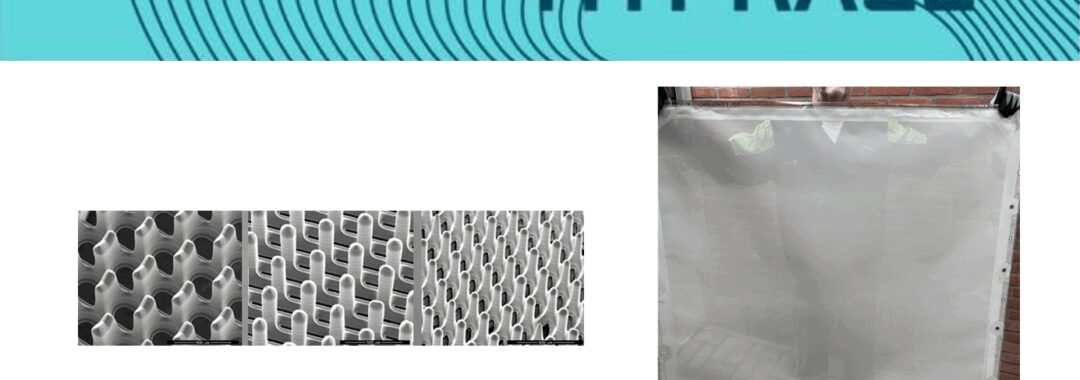
VECO PRECISION has led the development of an innovative 3D structured substrate and electrode. The new substrate facilitates electrolyte delivery and gas bubble removal, crucial for operating at high current densities and temperatures. Validation by Computational fluid dynamic (CFD) simulation has confirmed the effectiveness of this design. The 3D electrode, optimised through simulation and extensive testing, has been shown to significantly reduce the cell potential in hydrogen evolution reactions (HER) and oxygen evolution reactions (OER), outperforming the expanded Ni grid.

Development of efficient and durable catalysts:

Fraunhofer IFAM has focused its efforts on the development of long-lasting catalysts for HER and OER. A specially designed test rig has made it possible to analyse the behaviour of various materials under extreme conditions (temperatures up to 120°C and KOH concentrations of 1-45 wt%.) The results show an increase in electrode activity with temperature, albeit with a limit at 100°C, and lower activity at high KOH concentrations due to decreased conductivity and increased viscosity.

Optimisation of DSE production by APS:

Fraunhofer IWS has established a manufacturing process to coat the Veco Pin substrate with corrosion-resistant and HER- and OER-active species. Optimisation of the atmospheric plasma spraying (APS) process has made it possible to produce homogeneous catalyst coatings on spacers up to 130 mm in diameter. Different Ni and NiAl-based materials have been tested, achieving defect-free coating adhesion and high layer homogeneity.

Contact us for more information about the Electrolysis advances!

electrolyser cost

Understanding electrolyzer costs: key to HYPRAEL’s innovation in green hydrogen production

The HYPRAEL project is dedicated to advancing the efficiency and scalability of green hydrogen production through innovative electrolyzer technologies. A crucial factor in achieving widespread adoption of this clean energy source is the cost of electrolyzer systems. Recent data and analyses on electrolyzer costs provide valuable context for understanding the importance of HYPRAEL’s work.

Key insights on electrolyzer costs:

According to the latest information on electrolyzer costs in Europe (EU27, EFTA, and UK), the overall cost of electrolyzer systems can be broken down into two main categories:

  • CAPEX (Capital Expenditure): This refers to the upfront costs of the electrolyzer system (EUR/kW) and includes components like the stack, balance of plant (BoP), other utilities, and other capital expenses.

  • OPEX (Operating Expenditure): This represents the ongoing costs associated with operating the electrolyzer system (EUR/kW/year).

These costs vary depending on the electrolyzer technology used, primarily alkaline and PEM (Proton Exchange Membrane) electrolyzers.

HYPRAEL’s role in addressing cost challenges:

The HYPRAEL project directly addresses the challenge of electrolyzer costs by focusing on:

  • Improving efficiency: HYPRAEL’s research aims to enhance the energy efficiency of electrolyzers, reducing the amount of electricity required to produce hydrogen and, consequently, the operating costs.

  • Developing advanced materials and designs: By innovating in areas like electrode materials, cell design, and system integration, HYPRAEL contributes to lowering the CAPEX of electrolyzer systems.

  • Scalability: HYPRAEL’s advancements are geared towards enabling the large-scale production of green hydrogen, which is essential for cost reduction through economies of scale.

Understanding the breakdown of electrolyzer costs, as highlighted in recent reports, underscores the importance of projects like HYPRAEL. By pushing the boundaries of electrolyzer technology, HYPRAEL is playing a vital role in making green hydrogen production more economically viable and accelerating the transition to a sustainable energy future.

Discover the report of the European Hydrogen Observatory!